You bought the dream block. Maybe it’s five acres of jarrah in Rosa Glen, or a ridge-line property in Yallingup Siding with ocean glimpses. You want peace, privacy, and a break from the city noise.
But there is a reality check that hits many new property owners in the Southwest: the further you are from the highway, the “dirtier” the grid power gets.
We see it all the time. You are at the end of a long, skinny rural feeder line. The lights flicker when the wind blows. Brownouts are common. And there is nothing worse than driving down from Perth for a long weekend, anticipating a glass of red by the fire, only to find the power tripped three days ago and the freezer full of bait and premium wagyu has completely thawed.
For premium properties in the Southwest, “Off-Grid” isn’t about camping anymore. It’s about having better power quality than the suburbs, with zero bills and zero reliance on the grid.
Off-Grid vs. Hybrid: What Do You Actually Need?
First, let’s clear up the terminology, because the sales brochures can be confusing.
- Hybrid Solar: You are still connected to the grid (Western Power). You have a battery to store solar for the evening, but if you drain the battery, you pull from the grid. This is standard for suburban Vasse or Dunsborough.
- Stand-Alone Power System (SAPS): You are completely severed from Western Power. You are your own utility company.
The “Connection Cost” Math
Why would you choose to cut the cord? Often, it’s purely financial. If you are building a new shed or studio 200 meters from the road, Western Power might quote you $30,000 to $50,000+ just to run the cable and install a transformer.
That is “dead money.” It buys you a connection to a grid that charges you quarterly supply fees and usage rates.
If you take that same $40,000 and invest it in a high-end SAPS (Stand-Alone Power System), you own the infrastructure. You have no quarterly bills, ever. And in a bushfire-prone area where the grid is often cut preemptively for safety, your lights stay on.
Designing for the “Perth Holiday” Load Profile
Designing a system for a holiday home is harder than designing one for a permanent residence.
Most solar quotes assume you live there 24/7 with a steady, predictable usage. But a Yallingup holiday home has a “feast or famine” energy profile. It sits empty for three weeks (drawing almost zero power), and then suddenly, it’s the school holidays. You have 10 people staying, the air conditioning is blasting, the pool pump is running, and the ovens are on for Christmas lunch.
The MaxSolar Strategy:
We don’t design for the empty weeks; we design for Christmas Day.
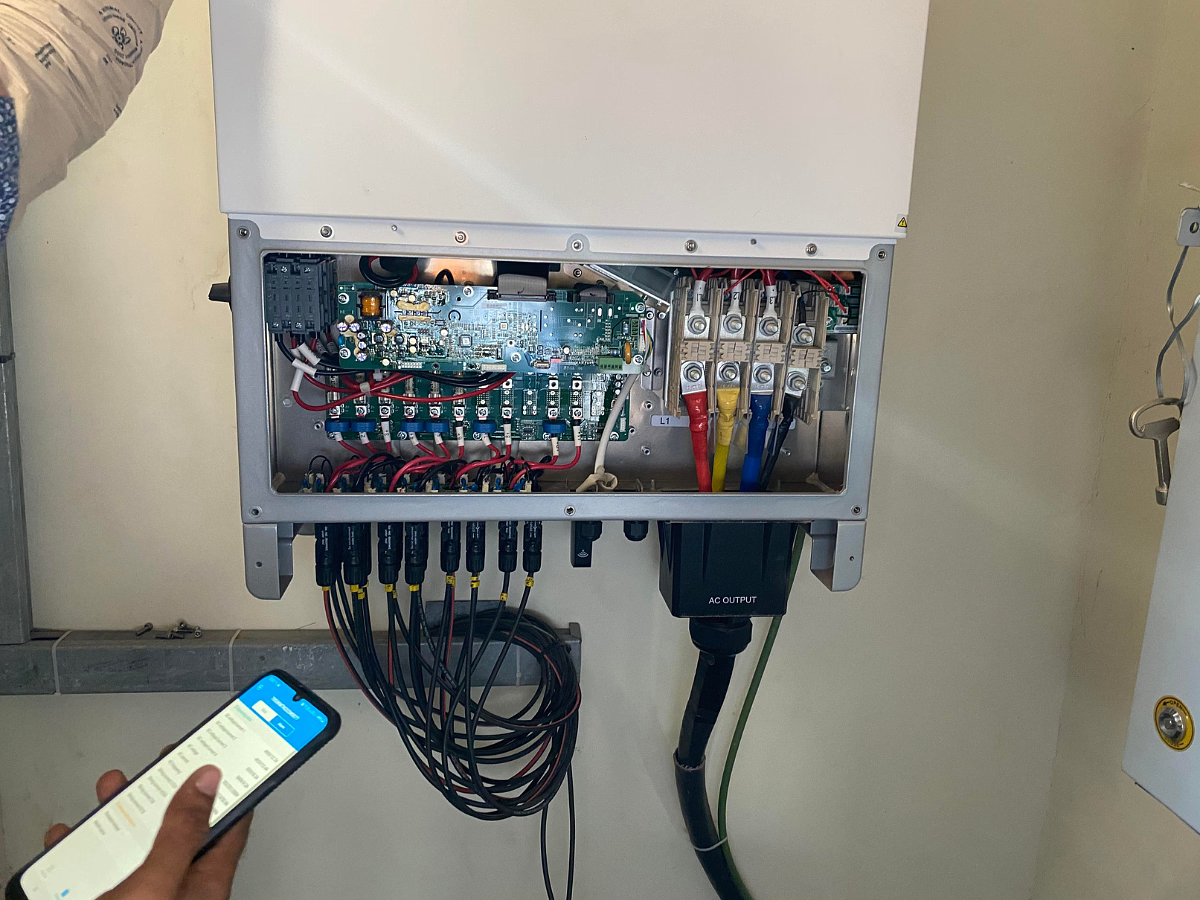
- Oversized Inverters: We install powerful inverters capable of handling high “surge loads” so the system doesn’t trip when someone turns on the kettle while the AC is running.
- Smart Monitoring: You need to see your system status from your phone in Perth. You should be able to check battery levels before you even pack the car.
- Auto-Generator Start: This is the ultimate backup. If it’s cloudy for five days in July, our systems can automatically signal a backup generator to kick in, top up the batteries, and shut down – all without you lifting a finger.
The Tech: This Isn’t Camping Gear
When we say “Off-Grid,” some people picture 12V camping panels and dim lights. That is not what we build.
We create a 240V Micro-Grid. We use AC-Coupling technology that mimics the frequency and voltage of the main grid perfectly. Your appliances, your Thermomix, your widescreen TV, your pool heater, won’t know the difference.
The “Guest Factor”
This is the most important test for a holiday home, especially if you Airbnb the property. The system must be seamless. Guests shouldn’t need a manual to turn on the lights. If they have to worry about “conserving power” or flipping switches, the system has failed. We use Lithium Iron Phosphate (LFP) batteries (like BYD or PowerPlus) that are safe, durable, and designed to handle the temperature swings of the Southwest bush without degradation.
Fire Safety & Bush Resilience
Yallingup and Margaret River are high fire-risk zones. This is where a SAPS offers a hidden safety benefit.
Running overhead power lines through trees on your property is a significant ignition risk. By going off-grid, you eliminate those lines.
At MaxSolar, we install strictly to AS/NZS 5139 (the Battery Safety Guide). This means:
- Fire-rated, dedicated enclosures for battery banks.
- Impact protection bollards (if installed in a garage).
- Remote shutdown capabilities.
We build systems designed to survive the environment they sit in.
Local Case Study: The Rosa Brook Eco-Chalet
We recently worked with a client in Rosa Brook who was building two luxury eco-chalets. Western Power quoted them nearly $80,000 to bring three-phase power to the new building site due to the rocky terrain and distance from the road.
Instead, we designed and installed a complete Stand-Alone Power System for approximately $45k.
The Result: They saved $35,000 upfront. They have zero ongoing power bills for the chalets. And when the massive storms hit last winter and their grid-connected neighbors went dark for 12 hours, their guests were warm, watching Netflix, with the lights on.
True Independence
A luxury property deserves a luxury power supply. Relying on “dirty” grid power at the end of a rural line is a compromise you don’t have to make.
Building a dream home or retreat in the Margaret River region? Send us your site plans before you pay Western Power a cent. Let MaxSolar design a power station that you own.