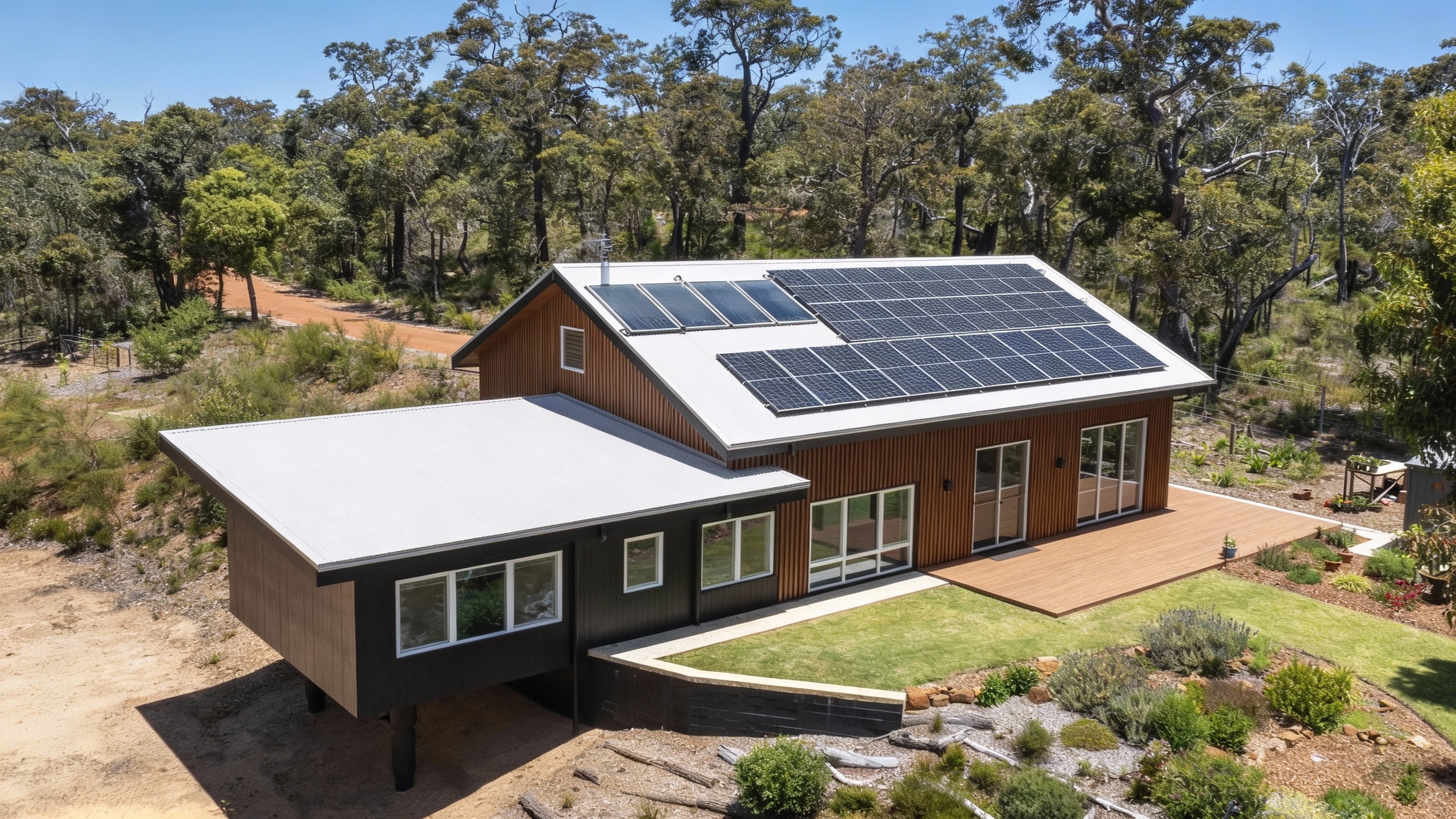
You bought in Margaret River for the silence, the space, and the trees. You didn’t buy it for the flickering lights and the “unplanned outage” text messages from Western Power that seem to be happening more often this summer.
The reality is that the Southwest Interconnected System (SWIS) is aging. But in 2026, it’s facing a new pressure: the massive influx of Electric Vehicles (EVs) charging in Dunsborough, Yallingup, and Margs. The local infrastructure is struggling to keep up with the demand.
For a premium lifestyle property in 2026, relying solely on a thin copper wire running through 20km of bushland is a risk you don’t need to take. Whether it’s a full off-grid disconnect or a “grid-protected” hybrid system, taking control of your power is the ultimate property upgrade.
The “End of Line” Problem in 2026
To understand why your lights flicker, you have to think of electricity like water pressure. By the time the power travels from the substation, down kilometers of rural lines to your block, the “pressure” (voltage) drops.
The New 2026 Stressor
A few years ago, this was just an annoyance. But now, as more neighbors add high-draw appliances (like fast EV chargers and induction cooktops) the voltage sag on these rural lines is getting significantly worse.
We are seeing three major symptoms on lifestyle blocks:
- 1.LED Disco: Your lights flicker noticeably in the evening when everyone gets home and starts cooking/charging.
- 2.The EV Charger “Pause”: Smart EV chargers are designed to protect your car. If the grid voltage drops too low (which is common at the end of a rural line), the charger will simply refuse to charge. You wake up expecting a full battery, only to find you’re stranded with 20% range.
- 3.Solar Tripping: Ironically, during the day, the voltage can spike too high due to solar saturation, causing your inverter to shut down to protect itself.
The consequence? You have a million-dollar view, but you can’t charge the car and run the AC at the same time.
Storms, Trees, and the 3-Day Blackout
Margaret River is beautiful because of the Karri and Marri trees. But in a storm, those trees are the enemy of overhead power lines.
It’s not just about total power loss. It’s the “brownouts” (low voltage events) that are the silent killers. These fluctuations can burn out the motors in expensive fridges, pool pumps, and bore pumps over time.
The Lifestyle Impact
If you run a holiday rental or Airbnb, reliability is currency. A 24-hour blackout isn’t just an inconvenience; it’s a refund you have to pay to angry guests who couldn’t shower or cook.
The MaxSolar Fix:
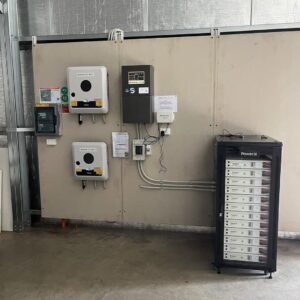
We install battery systems with “Island Mode.” When the grid goes down, your house instantly disconnects from the street and runs purely off the battery. The switchover is so fast (often less than 20 milliseconds) that your digital clocks won’t even reset. You might not even notice the street is dark until you look out the window.
The “Connection Cost” Shock (New Builds & Renos)
We see this scenario constantly: You want to build a studio, a chalet, or a big shed 100m from the main house. You call Western Power, and the quote makes your eyes water $25,000 to $50,000 just to run a new cable or upgrade your transformer.
The Pivot:
For that same money (or often less), you could install a Stand-Alone Power System (SAPS).
The Math is Simple:
- 1.Grid Connection: $40k. This is a sunk cost. You get nothing for it but a quarterly bill.
- 2.Off-Grid Solar: $40k. This is an asset you own. You have zero bills forever.
Plus, there is the “Green Bonus.” You don’t have to clear a corridor of trees for power poles, and you don’t have ugly overhead lines ruining your view of the ridge.
It’s Not Just About “Going Off-Grid” (The Hybrid Middle Ground)
There is nuance here. You don’t have to cut the wire if you don’t want to.
For many properties already connected to the grid, the best solution is a “Grid-Interactive” Battery.
- You run on solar and battery 95% of the time.
- You keep the grid purely as a “backup generator” for those weeks where it rains for 5 days straight in July.
Voltage Smoothing
Crucially, a high-quality inverter (like the Selectronic or Victron units we use) acts as a firewall. It takes the “dirty,” fluctuating grid power and “cleans it up” before sending it to your appliances. This protects your expensive electronics from the grid’s instability.
MaxSolar’s “Bush-Ready” Standards
Why choose us? Because we aren’t a Perth sales team sending a van down for the day. We live here. We know the soil types (which affects electrical earthing), the wind loads, and the fire risks.
- The Gear: We use equipment rated for high humidity and salt. Even inland, the salt mist gets in.
- Vermin Proofing: We know that rats and possums love chewing solar wires in sheds, so we use vermin-proof cabling and conduit.
- Local Support: If your power goes out on a Friday night before a dinner party, you need a local mobile number, not a call center in Manila.
Power is the Ultimate Luxury
In Margaret River, self-sufficiency isn’t a hippie dream anymore; it’s a smart infrastructure decision for high-value properties.
Tired of the flicker? Building a new holiday home? Contact MaxSolar for a site assessment. Let’s design a power system that matches the quality of your property.
Frequently Asked Questions
My EV charger keeps stopping. Is it my car or the grid?
If you live on a rural block, it’s likely the grid. EV chargers have strict safety voltage limits. If your neighbor turns on a welder or a pump and the grid voltage sags, your charger will “pause” to protect the car. A battery system with “voltage support” can fix this by filling in the gaps, ensuring your car charges smoothly even when the grid is wobbly.
Can I disconnect from the grid later if I install a hybrid system now?
Yes, provided you choose the right inverter now. Some cheaper “string” inverters can’t work off-grid. If you install a “hybrid-ready” or “multi-mode” inverter (like Selectronic or Deye), we can simply come back later, add more batteries, and physically disconnect the grid cable. It’s a great way to transition in stages.
Do I need a generator if I have a battery?
For a pure off-grid system? Yes, we always recommend a backup generator for the “1-in-10-year” storm event. For a grid-connected hybrid system? No. The grid acts as your generator. If the battery runs flat, you just pull from the grid automatically.
How long does a battery last in a blackout?
It depends on what you run. A standard 10kWh battery will run your lights, fridge, TV, and internet for a full evening and night. If you want to run the whole house (including AC and pumps) during a blackout, we might recommend stacking 2 or 3 batteries to give you 20-30kWh of storage. We size this based on your specific “survival” needs.
I heard Western Power is giving people free off-grid systems (SAPS). Can I get one of those?
This is a common question. Western Power is rolling out utility-owned SAPS to replace long, unreliable rural lines. However, you cannot simply “apply” for one. They select properties based on their network needs, not yours.
The Catch: If you do get a Western Power SAPS, you don’t own it. You still pay them a daily supply charge and per-unit usage fees, just like you are on the grid. You are essentially renting a battery in your own paddock. With a MaxSolar private system, you own the asset, and you never pay a bill again.
If I go off-grid, do I have to change my lifestyle? (The "Blue Sky" Rule)
In the old days, yes. You had to wash clothes only at noon. With modern “Lifestyle” systems, we design around you.
While it is always smart to run heavy loads (pool pumps, washing machines) when the sun is shining to save battery cycles, our high-capacity inverters mean you can absolutely cook a roast dinner at 7 PM while the AC is running. We design the system to match your habits, not the other way around.
Will an off-grid system hurt my property resale value?
In 2026, the market has flipped. A certified, high-end off-grid system is now seen as a premium asset, much like a bore or a large rainwater tank. Buyers in Margaret River are terrified of power bills and outages. Being able to market your property as “100% Energy Independent & Blackout Proof” is a massive selling point, provided the system is professionally installed and documented (which we handle).
What happens if my EV charger draws more power than the inverter can handle?
We use “Dynamic Load Balancing.” The EV charger talks to the inverter. If you turn on the oven and the AC, the house gets priority, and the EV charger automatically throttles down. As soon as you turn the oven off, the EV charger speeds back up. You don’t trip the system; it just manages the flow intelligently in the background.
Can I start with a Hybrid system and go Off-Grid later?
Yes, but you must choose the right inverter now. Many standard solar inverters cannot function without the grid. We install “Multi-Mode” inverters (like Selectronic or Deye) that work happily on-grid today, but can be physically disconnected from the street tomorrow with a simple software change and perhaps some extra batteries. It’s the best way to “future-proof” your renovation.